
Most foreign buyers spend weeks comparing properties in Punta Cana — and less than five minutes evaluating the person presenting them. That is backwards. In the Dominican Republic, the real estate agent profession is not regulated: there is no license requirement, no mandatory training, and no professional board overseeing conduct. Anyone with a phone and a social media account can call themselves an “investment advisor” tomorrow morning.
This is not a reason to avoid the market. It is a reason to do your own due diligence — on the intermediary, not just the property. At Punta Cana Investment Intelligence, we do not sell property and we do not earn commissions on what you buy. What follows is the framework we would want every investor to apply before trusting anyone with their capital.
Why the intermediary is itself a risk factor
Research on investor behavior in Punta Cana’s tourism real estate market shows that what buyers actually purchase from an agent is not a property — it is trust: guidance through financing, title, tax compliance, rental administration, and the legal handling of a foreign investment. When that guidance is absent, the buyer absorbs risks they never priced in.
The market has also changed. A new generation of real estate marketing — highly produced videos, aspirational lifestyle content, personal-brand billboards — has made it harder than ever to distinguish genuine expertise from good editing. Production value is not competence. A cinematic walkthrough of a penthouse tells you the agent hired a talented videographer. It tells you nothing about whether they understand CONFOTUR’s first-buyer rule or how a Dominican mortgage actually works.



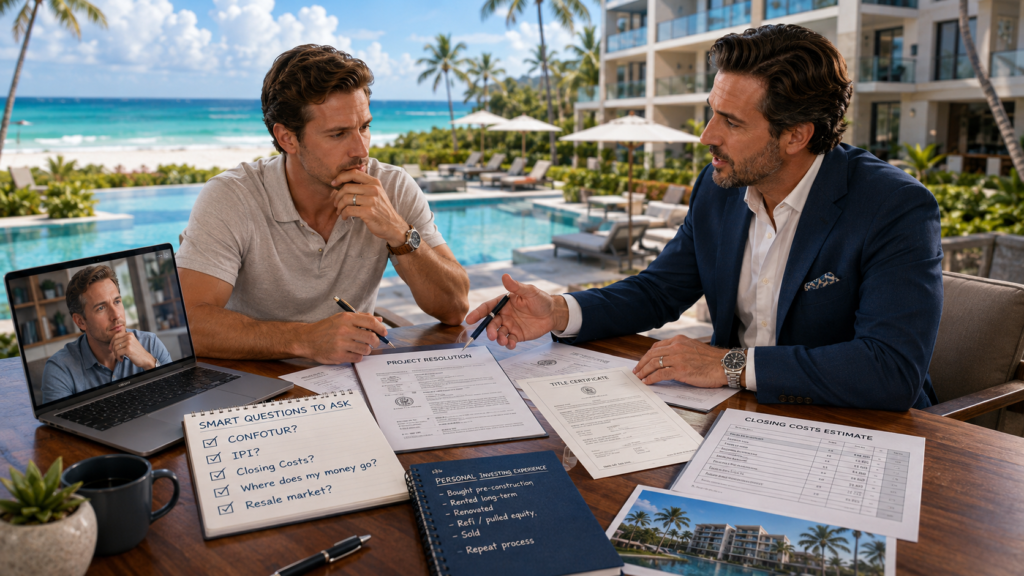
The four signals that separate advisors from salespeople
1. Look at what they publish when they are not selling
Scroll through the agent’s content. If every post is a property — square meters, ocean views, “imagine yourself here” — and none of it explains process (how closings work, what taxes apply, what can go wrong), you are looking at a salesperson. An advisor educates even when there is nothing to sell, because their value lies in what the client cannot see: the legal, fiscal, and operational mechanics behind the transaction.
2. Don’t confuse production quality with expertise
Polished videos, drone shots, and charismatic presenters are marketing assets, not credentials. Some of the most-followed real estate accounts are run by skilled content creators who have never closed a complex cross-border transaction. The test is simple: strip away the visuals. Is there substance left? If the answer is no, you have found a content creator — possibly a very good one — but not an advisor.
3. Apply the question test
Before any video call or presentation, prepare a written list of technical questions and watch how the person handles them. People reveal more by what they do than by what they say. Questions worth asking:
- Under CONFOTUR, who exactly qualifies for the tax exemptions — and do they transfer if I resell? (They do not: the benefit applies only to the first buyer purchasing directly from the developer.)
- What is the IPI, what is the current exemption threshold, and will I owe it?
- Where does my pre-construction money go during the build, and what protects it?
- Does this project have definitive CONFOTUR classification, or only provisional? Can I see the resolution number?
- What are the total closing costs, including transfer tax and legal fees?
- What is the realistic resale market here — who buys second-hand units, and how long do they sit?
An advisor answers these directly or tells you honestly what needs verification. A salesperson redirects to the amenities.
4. Ask whether they have skin in the game
Someone presenting “investment opportunities” who has never invested is describing a theory. Ask directly: have you personally bought in this market? What went well, and what went badly? Honest answers about past mistakes are worth more than a perfect track record narrative — the person who admits “I overpaid on my first pre-construction unit and here is what I learned” understands risk in a way no brochure conveys.
The part nobody wants to hear: your responsibility
When an investment underperforms, the reflex is to say “I was misled.” Sometimes that is true — this market has its share of bad actors. But in many cases the warning signs were visible: no technical answers, no documentation offered, no verifiable track record, pressure to decide quickly. If a person cannot answer your questions and offers only a beautiful apartment and a confident smile, the information you needed was already in front of you.
Investors who treat losses as lessons improve. Investors who treat every disappointment as a scam learn nothing and repeat the cycle. Due diligence is not paranoia — it is the price of operating in an unregulated intermediary market, and it is fully within your control.
FAQ
Are real estate agents licensed in the Dominican Republic? No. Unlike the U.S., Puerto Rico, or Spain, the DR does not license or regulate real estate agents. Professional associations exist, but membership is voluntary. This makes independent verification of everything an agent tells you essential.
Is a big social media following a sign of credibility? It is a sign of marketing skill. Audience size correlates with content quality, not advisory competence. Apply the four signals above regardless of follower count.
Should I avoid agents entirely and buy directly from developers? Not necessarily. A genuine advisor adds real value navigating a foreign legal system. The point is not to avoid intermediaries — it is to select them with the same rigor you apply to the property itself.
What documents should any credible intermediary be able to produce? The project’s CONFOTUR resolution (if claimed), the developer’s corporate identity, title documentation for the land, and a clear written explanation of how and by whom they are compensated.