
The sales pitch ends at closing. For a growing number of Punta Cana condo owners, that is exactly where the real cost begins. You pay US$100,000–300,000 for a unit, wait two or three years for delivery — sometimes five — and when the keys finally arrive, so does a management company you never chose, with a name you don’t recognize, that turns out to answer to the same group that sold you the unit.
Owners’ advocates in the Dominican Republic have a blunt name for what that structure becomes: a prisión financiera — a financial prison. Not every developer builds one; there are serious firms in this market that hand a building over cleanly. But the pattern is common enough that it belongs in every buyer’s due diligence, and the complaint data backs that up: in the first quarter of 2026 alone, Pro Consumidor logged 1,484 consumer complaints and listed real-estate damage, contract breaches and failed deliveries among the most frequent causes.
How the extraction works, in three acts
Act 1 — Sell, then delay
Pre-construction buyers — many of them Dominicans living in the U.S. and Europe, plus foreign investors — fund the project through staged payments. Delivery slips by years. Then comes the “adjustment”: a post-signing price increase blamed on rising material costs. Any developer pricing a two-to-three-year build can see that risk coming, which is why it belongs in the contract, not in a surprise invoice. Pro Consumidor’s director has said that about 70% of the real-estate complaints the agency received in 2023–2024 involved price increases on housing projects.
Act 2 — Deliver short
What arrives is often less than what was sold:
- Common areas unfinished or downgraded — a pool left incomplete, a “gym” that is two or three machines, a “kids’ area” that is a single swing.
- Amenities that quietly disappear — promised in the brochure, postponed at delivery, forgotten two or three years later.
- Parking bays too narrow to fit two full-size vehicles.
- Construction defects answered with a contract clause saying the warranty was “one year”.
Act 3 — Never leave
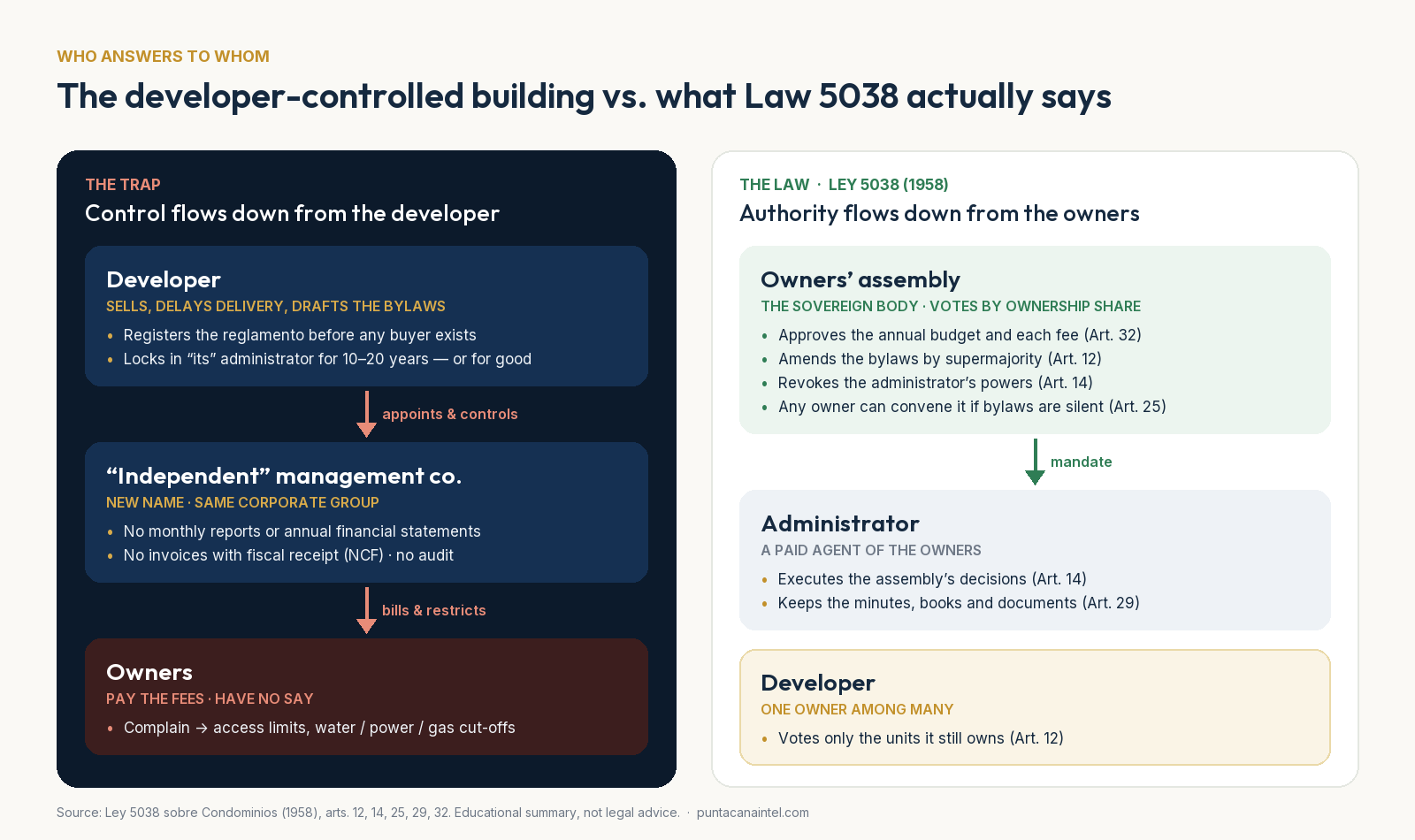
This is the part that turns a bad delivery into a long-term extraction. Under Law 5038, the condominium bylaws (reglamento de condominio) must be registered together with the building (Art. 21) — which means the developer writes them before a single buyer exists. Some use that pen to appoint the building’s administrator for 10, 15 or 20 years, and the boldest for an indefinite term. The administrator is usually a company with a different name from the developer, but the same people behind it.
Once installed, the playbook is consistent:
- Financial opacity. No monthly reports, no annual financial statements, no invoices with a fiscal receipt number (NCF) for what the fees pay for.
- Funds handled without oversight — no external audit, no budget approved by the owners.
- Retaliation against owners who complain: restricted access to common areas and, in the worst cases, water, power or gas cut off to the unit.
Why an investor should care: the maintenance fee is the largest recurring cost in your net-yield math. An administrator who answers to the developer instead of the owners controls that line — and every reserve, repair and special assessment behind it.
What the law actually says
The legal architecture is on the owners’ side. The problem is that most owners don’t know it — and a developer-drafted reglamento is not going to tell them.
1. The owners are the boss — by law
Law 5038 on Condominiums (1958) makes every unit owner part of a consortium of owners that exists “obligatorily and by operation of law” and acts through an administrator (Art. 9). The administrator executes the assembly’s decisions (Art. 14) and runs the building “under the authority of the general assembly” (Art. 29). Ordinary expenses follow a budget the owners approve every year, and each owner’s fee is set in the minutes of the assembly that approves it (Art. 32). The minutes, the books and the receipts for every expense are in the administrator’s custody (Art. 29) — custody, not ownership.
Crucially, the administrator’s powers “are revoked in the same way they were granted” — by the consortium of owners, or by a justice of the peace (Art. 14). And if the bylaws don’t say how to call an assembly, any owner can convene one with three days’ notice, by newspaper notice and certified letter (Art. 25). The bylaws can shape those procedures, which is exactly why a developer-drafted reglamento deserves your own lawyer’s read.
2. The developer’s head start is temporary
It is normal for the developer to name the first administrator: while nobody else has bought, it is the only owner. But every delivered unit adds a voter, and votes are weighted by ownership share (Art. 12), so the developer keeps voting only the units it still holds. One caveat matters for your math: in a building that is still half unsold, the developer may still control the majority. Knowing that number before you buy is part of due diligence.
3. Abusive clauses are void
Law 358-05 on Consumer Protection is public-order law. Its Article 83 declares null and without effect any clause that exempts the provider from liability for defects affecting a product’s essential purpose, limits or waives the rights the law grants consumers, or favors the provider excessively or disproportionately. A 20-year or perpetual administration clause written by the seller, in a contract the buyer could not negotiate, is the kind of clause owners’ lawyers challenge on exactly these grounds. Article 81 adds that adhesion contracts — standard-form contracts like most purchase agreements — must be submitted to Pro Consumidor for registration and review. Many never are.
4. A “one-year warranty” doesn’t erase ten-year liability
Article 1792 of the Dominican Civil Code holds the architect and the contractor liable for ten years when a building perishes in whole or in part because of a construction or ground defect. It covers defects that compromise the soundness of the structure, not cosmetic finishes — but, as Dominican attorneys have pointed out in the trade press this year, a contract clause cannot cut short a protection of public order.
5. Cutting utilities to punish a complaint has a fast remedy
The juez de los referimientos — the Dominican summary-proceedings judge — can order urgent measures to prevent imminent harm or to stop a “manifestly unlawful disturbance” (Law 834-78, Art. 110). A water, power or gas cut-off used as retaliation is precisely the kind of situation that procedure exists for.
The owners’ playbook: if you’re already inside
- Organize and document. Form an owners’ committee. Gather the purchase contracts, a certified copy of the registered reglamento from the Registro de Títulos, every payment receipt, photos of defects and undelivered amenities, and written requests for financial statements — sent in a way you can prove (certified letter or notarial act).
- Retain an independent condominium-law attorney (propiedad horizontal). True specialists are few — vet them the way you would vet the person selling you property — and never use the developer’s.
- Convene the assembly. Follow the procedure in your bylaws, or Article 25 if they are silent. Put it on the agenda: approve a budget, demand accounts, commission an audit and — if warranted — revoke and replace the administrator.
- File with Pro Consumidor over abusive clauses, breach of contract and undelivered amenities. The agency reports that about 90% of the cases it registered in early 2026 were resolved through conciliation, without a lawsuit.
- Go to the juez de los referimientos for anything urgent: utility cut-offs, blocked access, retaliation.
- Don’t wait. Legal claims have deadlines, and every year spent “being patient” is a year the clock runs in the developer’s favor. Ask your attorney which limitation periods apply to your claims.
Before you buy: five things to check in the reglamento
For investors still shopping, prevention is far cheaper than an assembly fight. Ask for the draft reglamento de condominio along with the promise of sale, and have your own attorney check:
- The administration term. A named company locked in beyond a short transition — or “indefinitely” — is a red flag. You want the owners’ assembly to choose, or at least confirm, the administrator.
- Who the administrator really is. Look the company up in the commercial registry (Registro Mercantil) and compare its shareholders and managers with the developer’s.
- Budget and reporting rules. An annual budget approved by the assembly, periodic financial reports, an annual statement, a reserve fund and the right to an external audit.
- The voting math. How many units will the developer keep, and for how long? If it can outvote buyers indefinitely, the assembly is decorative.
- Amenities in writing. Pool dimensions, gym equipment, parking bay sizes and delivery dates belong in a contract annex with penalties — not in the brochure. And ask whether the contract was registered with Pro Consumidor.
Run any specific deal through the free Deal Risk Score — 7 questions, a due-diligence score, and exactly what to verify next. Then work the paper with the due-diligence checklist.
The same discipline applies further upstream: the five red flags to check before you wire a deposit, what a fideicomiso really protects, and the 9-step closing process. A building is only as good as the people who run it — and under Dominican law, the people who run it work for you.
Educational content, not legal advice. Legal references: Law 5038 on Condominiums (1958), arts. 9, 12, 14, 21, 25, 29 and 32; Law 358-05 on Consumer Protection, arts. 81 and 83; Dominican Civil Code, art. 1792; Law 834-78, art. 110. Complaint figures: Pro Consumidor, as reported by El Inmobiliario (April 2026). Retain an independent Dominican attorney — not the developer’s — before acting on any specific case.
