
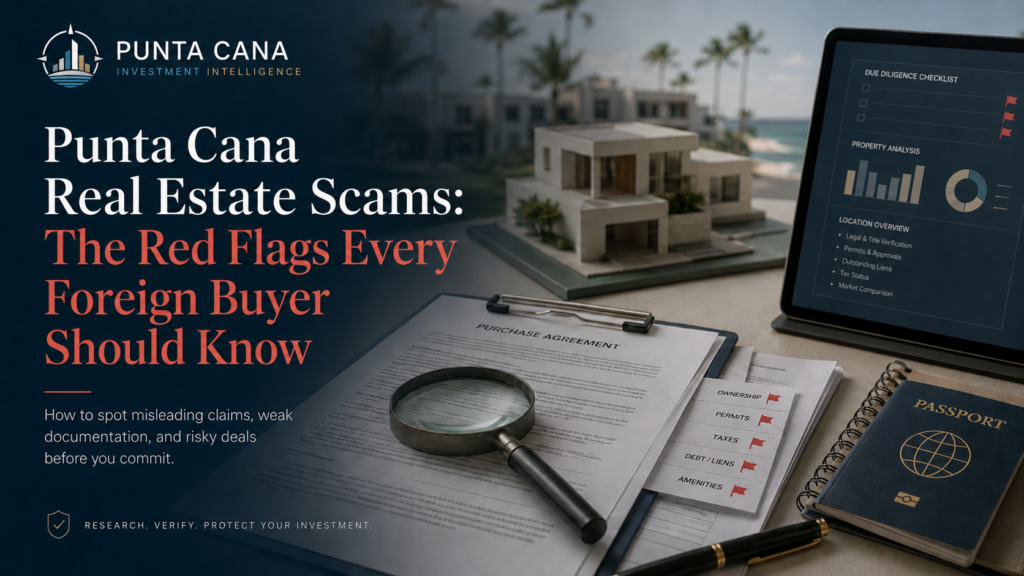
Punta Cana is one of the Caribbean’s most active property markets, and that activity attracts both genuine opportunity and people looking to take advantage of buyers who don’t know the local system. Here is the honest framing most sales pages won’t give you: real estate fraud in the Dominican Republic is real and more common than in many comparable markets — but it is also, in the large majority of cases, preventable. Almost every loss traces back to the same handful of skipped checks.
This guide is not here to scare you out of investing or to sell you anything. It walks through who gets targeted, the scams that recur most often, the documents that actually protect you, and the specific red flags that should stop a deal in its tracks.
Who scammers target
The pattern is consistent. The buyer most often targeted is a first-time foreign purchaser who doesn’t speak Spanish, is shopping remotely or online, and feels pressure to “lock in” a deal quickly before doing independent verification. Tourist hotspots like Punta Cana see more of this simply because that’s where foreign money concentrates.
Notice that none of those risk factors is about the property — they’re about the buyer’s position. Distance, language, unfamiliarity, and urgency are what get exploited. The good news is that every one of them can be neutralized with process. The buyer who slows down and verifies independently is no longer the easy target.
The single biggest red flag
If you remember one thing from this page, make it this: be very cautious of anyone who asks for a deposit before you can independently verify the property’s legal status in the Registro Inmobiliario (the national Land Registry).
A legitimate seller has nothing to hide from a registry check and no reason to rush you past it. Pressure to pay a “reservation deposit” to hold the price, or a deadline that conveniently falls before your lawyer can verify the title, is the most reliable warning sign that something is wrong. Money that moves before paperwork is verified is money that can disappear.
The scams that recur most often
Title fraud. The seller doesn’t actually own the property, or the documents are forged. Without an independent registry search, a forged title can look convincing.
Double sales. The same unit or parcel is sold to more than one buyer. Whoever registers first and cleanly can end up the legal owner — and the others are left with a lawsuit instead of a property.
Phantom preconstruction. A developer sells units in a building that isn’t legally approved, or that never gets built. Deposits are collected and the project stalls or vanishes. Preconstruction and “reservation deposit” deals are the most frequently abused transaction type precisely because money changes hands long before delivery.
Unregulated “agents.” The real estate profession in the Dominican Republic is largely unregulated — there is no licensing requirement, so anyone can call themselves an agent. Some collect deposits or fees for properties they have no right to sell, or misrepresent value, zoning, or condition.
The “preferred lawyer” trap. If the seller or developer pressures you to use their attorney, that is a conflict of interest, not a convenience. Your lawyer should answer to you and only you.
Deposits with no safety net. True escrow accounts are rare in the Dominican market, and title insurance is uncommon. Buyers often wire large sums directly to a seller or developer with no safeguard — which is exactly why the protections below matter so much.
The documents that actually protect you
Most fraud collapses the moment these are verified. Treat them as non-negotiable.
- Certificado de Título — the Certificate of Title, your proof of legal ownership. It must be properly registered.
- Certificación del Estado Jurídico del Inmueble — a certification of the property’s current legal status, showing liens, mortgages, or disputes attached to it.
- Deslinde — the legal boundary survey, conducted by a certified surveyor and registered with the title. A property without a completed, registered deslinde is a major red flag; without it, boundary disputes are nearly guaranteed.
- Plano catastral — the registered survey plan held at the Land Registry. It should match the description on your title certification and the physical reality on the ground.
- Lien and debt search — your attorney should check for liens, unpaid taxes, utility debts, and pending litigation. Records can sit in more than one office, so this takes real legwork.
- IPI certification — confirmation from the DGII (the tax authority) that the property tax is paid and current. (See our IPI guide for how that tax works.)
- Permits and zoning — confirmation from the municipality that the property was built with the correct permits and can legally be used as you intend.
A red-flag checklist
Any one of these is reason to slow down and verify before money moves:
- You’re asked for a deposit before an independent registry check.
- The seller can’t produce a clean Certificado de Título and a registered deslinde.
- You’re pushed to use the seller’s or developer’s “preferred lawyer.”
- There’s urgency or a countdown — “another buyer is interested,” “the price goes up Monday.”
- You’re asked to wire funds directly to an individual with no escrow or trust in place.
- A preconstruction project can’t show legal approval and permits.
- The agent has no verifiable track record, and won’t put claims in writing.
- The price is conspicuously below comparable units — too-good-to-be-true usually is.
How to protect yourself
The safe process isn’t complicated; it just has to be followed.
Hire your own independent attorney. Use a bilingual Dominican real estate attorney who works for you, not one recommended by the seller. Specialized attorneys typically charge around 1–1.5% of the purchase price — a small fraction of what a bad title can cost you.
Verify in the Registro Inmobiliario before any deposit. Confirm ownership, boundaries, and that the property is free of liens before money moves, not after.
For preconstruction, insist on a fideicomiso. A fideicomiso de garantía (a guarantee trust) holds your deposit in a regulated structure instead of in the developer’s pocket. Given how rare true escrow is, this is often the only thing standing between your money and a stalled project. Combine it with a check of the developer’s delivery history and the project’s permits and CONFOTUR status.
Never let urgency override verification. Real opportunities survive a two-week due diligence period. Manufactured urgency is a tactic, not a reason.
Put it in writing. Verbal promises about returns, finishes, or timelines are worth nothing in a dispute. If it matters, it belongs in the contract.
Frequently asked questions
Is it safe to buy real estate in Punta Cana? Yes, for buyers who verify. Foreigners have the same ownership rights as nationals, and most losses come from skipping due diligence rather than from anything unique to the country. The risk is the unverified deal, not Punta Cana itself.
What’s the most common scam? Preconstruction and reservation-deposit deals, where money is collected before the legal status and permits are confirmed and the project then stalls or was never approved.
What is a deslinde and why does it matter? It’s the registered legal survey that defines a property’s exact boundaries. Without it, you can’t be certain what you’re actually buying, and boundary disputes become very likely.
Do I need a lawyer, and can’t I just use the seller’s? You need your own independent attorney. A lawyer tied to the seller or developer has a conflict of interest. Independence is the protection.
Is there escrow protection like in North America? Rarely. True escrow accounts and title insurance are uncommon, which is why a fideicomiso for preconstruction and a thorough registry check before any payment are so important.
How much does proper due diligence cost? A specialized attorney generally charges about 1–1.5% of the purchase price. Compared to the cost of a fraudulent or defective title, it’s the cheapest insurance you’ll buy.
Not sure how risky a specific deal is? → [Run the Real Estate Risk Score] Want the printable version? → [Download the Due Diligence Checklist]
This guide is educational and does not constitute legal advice. Real estate laws and procedures change, and every transaction is different. Always verify a property independently through the Registro Inmobiliario and engage a qualified, independent Dominican attorney before committing funds.
