
A Foreign Buyer’s Guide to the DR Tax Incentive (2026)
If you are researching property in Punta Cana, CONFOTUR is the single most important tax concept you need to understand — and also one of the most misrepresented in developer marketing. This guide explains what CONFOTUR actually exempts, who qualifies, how long the benefit lasts, and the details that quietly change how much you really save.
We are not selling property. The goal here is simply to give you an accurate, plain-English picture so you can evaluate any project on your own terms.
What CONFOTUR is
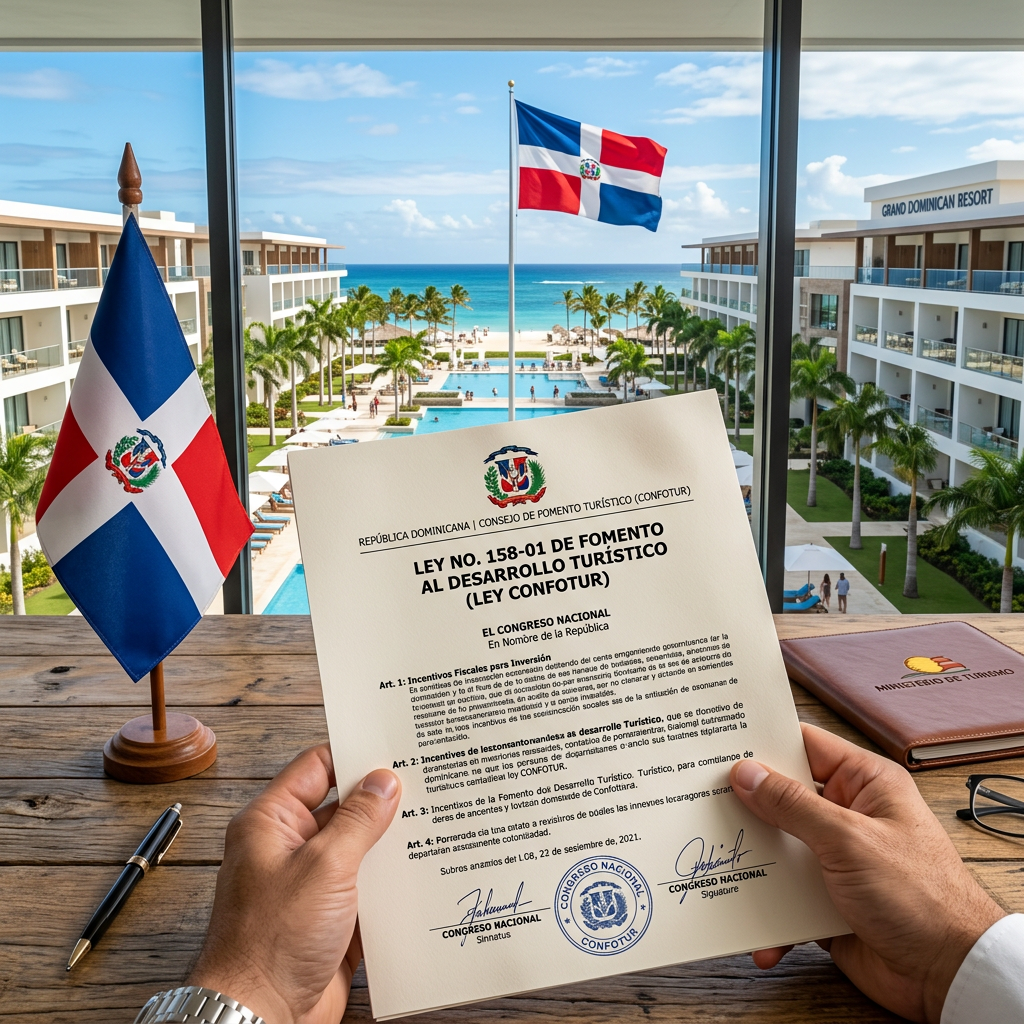
CONFOTUR stands for Consejo de Fomento Turístico (Tourism Promotion Council). It is the body that administers Law 158-01, a Dominican incentive framework created in 2001 and later refined by Laws 184-02 and 195-13. The council operates under the Ministry of Tourism (MITUR).
Its purpose is straightforward: to attract investment into designated tourism zones — Punta Cana, Cap Cana, Bávaro, Uvero Alto, Las Terrenas, Samaná, La Romana and others — by exempting approved tourism projects from a series of taxes. When a project earns CONFOTUR classification, certain benefits flow through to the people who buy units in it.
The key word is project. As you’ll see below, the incentive attaches to the development, not to you personally — a distinction that matters more than most buyers realize.
The two benefits that actually matter to a buyer
A CONFOTUR project carries many exemptions, but most apply to the developer (import duties, ITBIS on construction materials, corporate income tax). As a buyer, two benefits reach your pocket directly.
1. Exemption from the 3% Property Transfer Tax — a one-time saving at closing. Normally, registering a property in your name in the Dominican Republic costs 3% of its value in Impuesto sobre Transferencia Inmobiliaria. In a CONFOTUR project, the first buyer is exempt. On a US$300,000 property, that is US$9,000 you keep at closing. On US$500,000, it is US$15,000.
2. Exemption from the annual IPI property tax — for up to 15 years. The Impuesto al Patrimonio Inmobiliario (IPI) is a 1% annual tax charged on the value of a person’s Dominican real estate above an exempt threshold. For 2026 that threshold is RD$10,695,494, roughly US$182,206, and it is adjusted every year by the DGII. Under CONFOTUR, you are exempt from IPI on the property for up to 15 years.
A worked example
For a US$300,000 apartment in a certified project, held for the full exemption period:
| Benefit | How it’s calculated | Estimated saving |
| Transfer tax exemption | 3% × $300,000 | $9,000 (one-time) |
| IPI exemption (15 yrs) | 1% × ($300,000 − $182,206) × 15 | ~$17,669 |
| Total estimated saving | ~$26,669 |
You can run your own number — any price, any number of years — with our [CONFOTUR Calculator]. The figures above use the same 2026 threshold the calculator uses.
CONFOTUR vs. a non-CONFOTUR property
| Non-CONFOTUR | CONFOTUR | |
| 3% transfer tax at closing | You pay it | Exempt (first buyer) |
| Annual IPI (1% above threshold) | You pay it yearly | Exempt up to 15 years |
| Import duties / ITBIS on construction | n/a to buyer | Developer exempt |
| Net effect on your costs | Higher entry + holding cost | Lower entry + holding cost |
What developers don’t always tell you
This is where an objective guide differs from a sales page. None of the points below are secrets — they’re in the law — but they’re rarely highlighted, and each one affects your real benefit.
- The 15-year clock starts when the project is approved, not when you buy. If a development received CONFOTUR classification in 2023 and you purchase in 2026, you inherit the remaining years — not a fresh 15. Always ask what year the classification was granted.
- The benefit belongs to the project, not to you. Because the exemption attaches to the certified development, your eligibility depends entirely on that project’s standing — which is why verifying the certification (below) matters so much.
- Rental income is treated separately. CONFOTUR’s headline exemptions are the transfer tax and IPI. Money you earn renting the property out falls under Dominican income tax rules, with its own deductions and obligations. Don’t assume “CONFOTUR” means “tax-free rental income.”
- Resale is not automatic. The transfer-tax exemption is designed for the first acquirer of a new unit. If you buy a resale, what carries over (and what doesn’t) needs to be checked case by case.
- You don’t apply for it — but you should still verify it. The benefit activates through the developer and the project’s classification; the buyer doesn’t file separately. That convenience is exactly why you should confirm the certification is real and current rather than take it on trust.
How to verify a project is genuinely CONFOTUR-certified
Because the savings hinge entirely on the project’s status, treat verification as non-negotiable.
- Ask for the CONFOTUR resolution. A legitimate project has a classification resolution from the Ministry of Tourism. Request the number and the year it was granted. (See an example here.)
- Distinguish provisional from definitive classification. Projects can hold a provisional classification while requirements are still being completed. Know which one you’re dealing with.
- Confirm with the official source. CONFOTUR sits under the Ministry of Tourism at confotur.mitur.gob.do (a .gob.do government domain). The fiscal exemptions themselves are processed through the Ministry of Finance and the DGII.
- Don’t rely on a brochure or a verbal promise. “CONFOTUR approved” printed in marketing material is a claim, not proof. The resolution is the proof.
If a seller cannot produce the resolution, that is itself a red flag worth weighing in your overall risk assessment.
Do foreign buyers qualify?
Yes. You do not need Dominican residency to buy in a CONFOTUR project, and you can register the property in your personal name or through a company. The same buyer exemptions apply to nationals and foreigners alike.
Frequently asked questions
Does CONFOTUR make my rental income tax-free? No. It exempts the transfer tax and the IPI property tax. Income earned from renting the property is governed separately by Dominican income tax rules.
When do the 15 years start? From the project’s approval / completion, not from your purchase date. Buying into an older certified project means inheriting the time that remains.
Does CONFOTUR apply to resale properties? The transfer-tax exemption targets the first buyer of a new unit. For resales, what carries over should be verified individually.
Do I have to apply for CONFOTUR myself? No. The benefit is tied to the certified project and activates through the developer — but you should still confirm the certification independently.
How much can I actually save? It depends on price and how long you hold. Use the [CONFOTUR Calculator] to estimate your transfer-tax and IPI savings.
Is CONFOTUR legitimate? Yes — it is an established government incentive under Law 158-01. The risk is never CONFOTUR itself; it’s whether a specific project genuinely holds a valid classification.
Estimate your own CONFOTUR savings → [Open the CONFOTUR Calculator]
This guide is educational and does not constitute legal or tax advice. The IPI exempt threshold is set annually by the DGII and changes each year. Benefits apply to the first buyer of a new unit in a project holding valid CONFOTUR classification. Always verify a project’s certification and consult a qualified Dominican attorney or accountant before deciding.