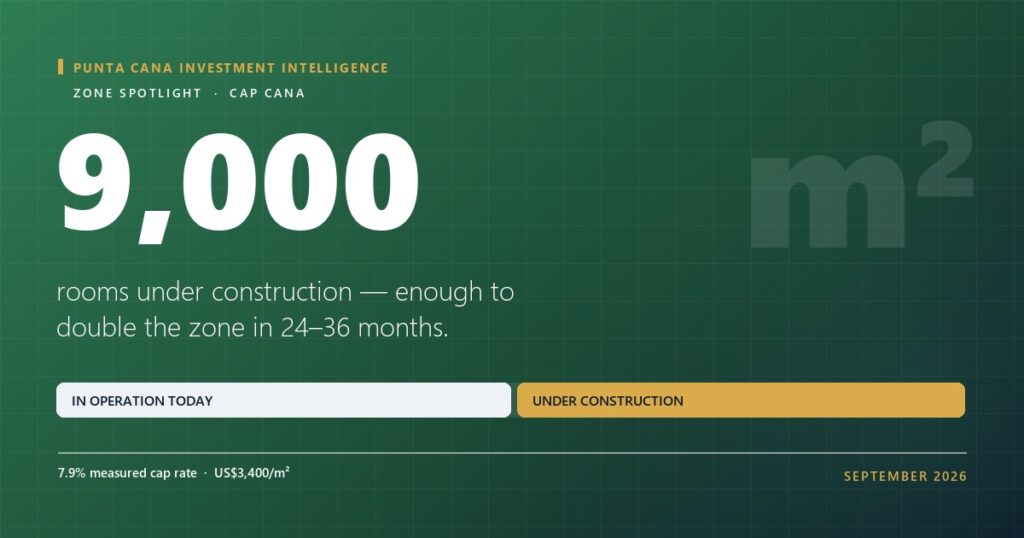
On August 31, 2026, Fernando Hazoury, president of Cap Cana’s board, put a number on something the cranes had been hinting at for two years: roughly 9,000 rooms are under construction in Cap Cana right now, across hotel and residential projects combined. More than 50 projects are being built simultaneously. The stated goal is to double the destination’s capacity within 24 to 36 months, to somewhere between 18,000 and 20,000 rooms.
For a destination, that is a triumph. For an investor who already owns — or is about to buy — a unit inside the gate, it is the single most important variable in the next three years of underwriting. Both things are true at once, and the gap between them is worth more than a point of cap rate.
Cap Cana in our zone dataset — October 2026 cut
Read this carefully: the 7.9% cap rate is what the zone returns at 60% occupancy. Occupancy is the assumption doing the heavy lifting, and occupancy is exactly what new supply competes for.
The pipeline is not just Cap Cana
Zoom out and the same picture repeats across the country. Asonahores, the Dominican hotel and tourism association, counts more than 90,000 hotel rooms in operation and expects the country to add 15,000 to 20,000 more over the next five years. Investment agreements announced at FITUR 2026 exceeded US$6 billion with the potential for around 11,000 new rooms; about 4,411 rooms were expected to be delivered by the end of 2026 alone.
Punta Cana takes the largest share of that. Lopesan opened three new concepts in 2026 — Caoba Lagoon, Serenity Bay and Splash Cove — adding more than 1,000 rooms on an investment above US$350 million. Hyatt’s Vivid Punta Cana was slated to open in the third quarter of 2026. Archipelago International and Tonino Lamborghini picked Cap Cana for their first Dominican development, a luxury hotel with a high-end residential component. And the growth is not confined to the coast: in September 2026 Grupo Nivel added a 111-room City Express by Marriott to its Aura Boulevard development, alongside roughly 900 residences and a retail component — inland density, on the corridor our dataset tracks as Downtown Punta Cana and Verón.
The bull case, stated fairly
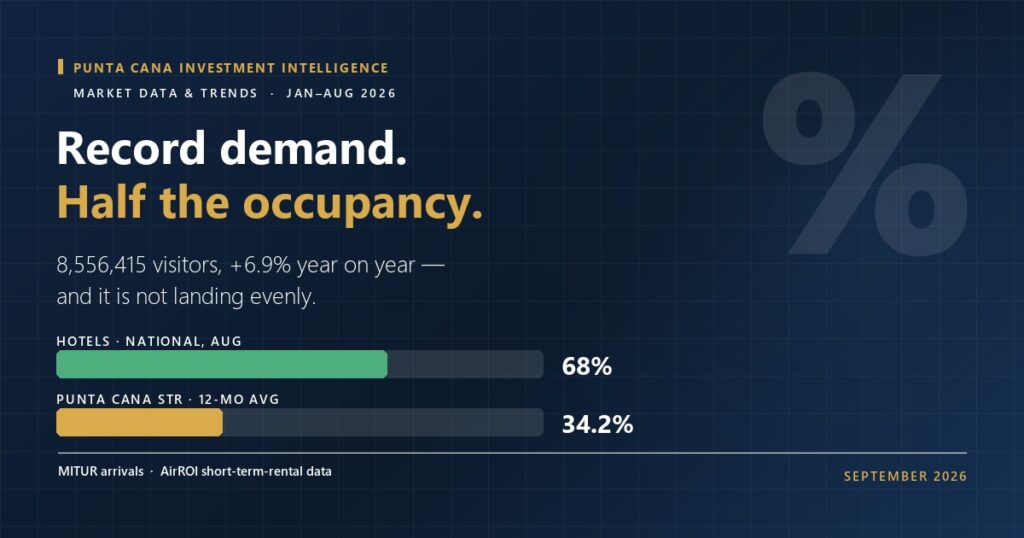
- Demand is genuinely growing. The country closed the first eight months of 2026 at a record 8.56 million visitors, up 6.9% year on year. Supply is chasing something real, not a hallucination.
- Brand density raises the ceiling. Every new Hyatt, Marriott or Lamborghini flag inside the gate makes the address easier to sell — to guests and, eventually, to your resale buyer.
- Amenities are the product. A new Jack Nicklaus-supervised golf course, more marina berths and more restaurants are consumed by existing owners for free. Cap Cana’s thesis was never scarcity of units; it was scarcity of this kind of place.
- Infrastructure follows rooms. Roads, power and staffing investment follow hotel capital, and they spill over onto residential values.
The bear case, stated just as fairly
Demand is growing at roughly 7% a year nationally. Cap Cana’s stated plan is to grow capacity by about 100% in 24 to 36 months. Even if every one of those rooms is eventually absorbed, the absorption and the delivery do not arrive on the same calendar. That timing mismatch is where returns get compressed.
Three specific mechanisms matter to a condo owner:
- New inventory competes on the same platforms. A branded residence with a professional rental program, a marketing budget and a fresh photo set is not a distant competitor to your resale unit — it is the listing directly above yours in the same search results.
- Deliveries cluster. Projects sold in the same 18-month window tend to complete in the same 18-month window, so the supply shock is lumpy rather than smooth.
- Discounting starts with the newest unit that needs to fill a calendar. ADR pressure usually shows up before occupancy pressure does.
What occupancy compression does to the Cap Cana cap rate
(today’s measurement)7.9%
Illustrative, holding ADR and the 50% expense ratio constant and letting net income move with revenue. Ten points of occupancy is worth roughly 7.9% → 6.6% — and that is before any ADR discounting. Run your own version in the ROI calculator.
Five things to do about it
- Ask for the delivery calendar within one kilometre. Not “is the area growing” — which projects, how many units, delivering which quarter. Your competition is a spreadsheet, not a feeling. Any serious broker can produce it; a broker who will not is telling you something.
- Buy the differentiated unit, not the commodity one. Beachfront, real views, unusual layouts and genuine privacy hold rate. A standard one-bedroom in a tower of 300 standard one-bedrooms is the single worst position to hold into a supply wave.
- Underwrite years one to three below the zone benchmark. If the brochure says 70%, and our zone measurement says 60%, model 50% and see whether you still like the deal. If it only works at the brochure number, it does not work.
- Read the rental-program terms before the finish package. In a market absorbing new supply, who fills your calendar and on what split matters more than the countertops. Check the exit terms too — can you leave the program?
- Price the alternative. The best measured cap rate in our table is currently Cap Cana at 7.9% — but Downtown Punta Cana measures 7.1% at US$1,955/m², and Bávaro 7.1% on a US$100,000 entry ticket, for a fraction of the capital at risk. Compare them side by side on the zone map, and read Cap Cana vs. Bávaro for the full trade-off.
Supply growth is not a reason to avoid Cap Cana. It is a reason to stop underwriting Cap Cana on 2024 occupancy assumptions.
Two things to verify before you sign
First, if the project you are shown claims CONFOTUR, get the resolution number and verify it — a wave of new launches is exactly when unverifiable claims multiply. Here is what Law 158-01 actually waives, and our members-only Verified CONFOTUR Project Database tracks approved projects against the MITUR registry.
Second, run the deal through the five red flags before any deposit leaves your account. Pre-construction is where the best prices in this cycle live, and where the losses live too.
One footnote worth holding on to: a slice of the competition you are worried about may be about to disappear. MITUR’s proposed short-term rental registry would remove unregistered listings from Airbnb and Booking — that story is here, and it cuts the other way on supply.
Sources
- Arecoa, “Hazoury: En Cap Cana se construyen 9,000 habitaciones entre hoteleras e inmobiliarias”, August 31, 2026.
- El Día, “RD se prepara para sumar hasta 20,000 habitaciones hoteleras en los próximos cinco años” — Aguie Lendor, Asonahores, August 9, 2026.
- Caribbean Journal, “Marriott-Branded Hotel Planned for Major Punta Cana Mixed-Use Development”, September 7, 2026.
- MITUR / Ministry of Tourism arrivals data, January–August 2026, announced September 13, 2026.
- Punta Cana Investment Intelligence zone dataset, October 1, 2026 cut. See the zone map for per-zone sourcing and “as of” dates.
Data as of September 2026. Zone metrics are market estimates built from documented official and secondary sources, not appraisals; the cap-rate scenarios above are illustrative arithmetic, not forecasts. Educational content, not investment advice.