
On May 20, 2026, the Dominican Ministry of Tourism (MITUR) opened public consultation on two draft resolutions that would have rewritten the rules for every short-term rental in the country. On July 20 — two days before that consultation was due to close — MITUR withdrew them.
It is tempting to read the withdrawal as “nothing happened.” That is the wrong lesson. A regulation four years in the making does not get abandoned because of a two-month consultation; it gets renegotiated. The draft that was pulled is the most detailed statement we have of what the Dominican state intends, and it is worth reading as a preview rather than a scare.
How we got here
- March 2022The process beginsMITUR starts work on a framework for short-term rentals. It takes more than four years to reach a published draft.
- May 20, 2026Public consultation opensTwo draft resolutions are published: one creating RENATUR, the national registry of tourist accommodation, and one setting requirements for vacation-rental properties. Comments were due July 22.
- July 20, 2026MITUR withdraws the draftTwo days before the deadline, the resolutions are pulled from the ministry’s portal to open a dialogue process with the sector.
- July 31, 2026ADORECO files its objectionsThe Dominican short-term rental association submits a formal risk matrix and legal analysis, and asks for a technical working group before anything is signed.
- PendingThe registry returnsNo published date. The dialogue table has been convened in principle; the substance of the registry has not been withdrawn, only its current drafting.
What RENATUR would have required
RENATUR — Registro Nacional de Alojamientos Turísticos — would be a mandatory national registry for villas, apartments, houses, rooms and bungalows offered as vacation rentals. Registration would be a precondition for marketing the property at all. The draft split the obligations three ways.
If you own the unit
- Register each property individually, with identity document, detailed location and contact information.
- Carry a civil liability insurance policy on the unit.
- Comply with your condominium’s decisions. This is the sharp edge: where the assembly had voted against short-term rentals, the unit could not be registered — even if it was already operating.
If you manage units for others
- Register every property under management, with requirements varying by whether the administrator is an individual, a company or a non-resident.
- Non-residents would need to designate a local “Service Provider” holding legal representation in-country.
- Individual administrators would need current DGII (tax authority) standing and a criminal-record certificate.
- “Host” was defined broadly — anyone managing guest interaction, in person or through automation.
If you are Airbnb or Booking
This is where the draft had teeth. Platforms would be required to demand proof of RENATUR registration from new listings, to give already-published properties 60 calendar days to regularise, and then to remove unregistered properties from their portals. They would also report guest “incidents” to MITUR, which could trigger revocation of a registration. In effect, the platforms would be converted from commercial intermediaries into the enforcement layer. Reports of the broader transition window for existing operators differed — three months in some accounts, six in others — but the 60-day platform rule was consistent across them.
The enforcement mechanism was never a tax inspector at your door. It was your listing quietly disappearing from search.
Why the state wants this
Because short-term rentals stopped being a fringe. Depending on what is being counted — units, properties or rooms — published estimates for the country range from roughly 57,000 properties at the end of 2025 to about 137,000 units nationwide. Against 94,309 hotel rooms across 1,030 registered establishments, the informal supply is no longer a rounding error on the formal one.
The supply MITUR is trying to bring onto the register
Counts vary by source and by definition — a “unit”, a “property” and a “room” are not the same thing, and one villa can be several of each. Treat the range as the signal, not any single number.
MITUR’s technical vice-minister, Jacqueline Mora, framed the goal as recognising short-term lodging as formal tourism supply, and stated that the draft created no new taxes and no operating licences — its function was to verify that properties comply with condominium rules and municipal ordinances, and to validate who the administrators actually are. Airbnb publicly backed the idea of a registry on July 22, while asking that the final rule stay “inclusive and proportional” and free of bureaucratic burdens that would push hosts back into informality.
Why it was pulled
ADORECO, the Dominican short-term rental association, supports regulation in principle and objected to this particular design. Its formal submission on July 31 flagged, among other things:
- The insurance product the draft required does not reliably exist in the Dominican market yet — a legal obligation to buy something not for sale.
- The registry could become a tax-collection instrument, despite the stated intent, once it exists.
- It excluded properties on land still going through deslinde (survey and segregation) — which, in fast-growing corridors, is a great many otherwise legitimate units.
- The drafting was legally vulnerable enough that the resolutions could be annulled in court, leaving everyone worse off than before.
What this does not change
Two things sit outside this fight entirely, and it is worth being precise about them:
- CONFOTUR is untouched. Law 158-01’s transfer-tax and IPI exemptions are a tax-incentive regime for classified projects; RENATUR is an operating registry. Different law, different ministry function, no interaction. What CONFOTUR actually waives.
- Law 85-25 is untouched. The 2025 rental law still does not apply to tourist rentals of 90 days or less, so your nightly and weekly bookings remain outside it. The 90-day line, explained.
Five things to do before the registry comes back
- Read your condominium rules today. This is the highest-value item on the list and it costs nothing. If your building’s assembly has banned or restricted short-term rentals, that is a problem for your business model with or without RENATUR — and under the draft it was disqualifying. If you are still shopping, get the condominium regulations and the last two assembly minutes before you make an offer.
- Check the deslinde status of the land. Ask for the parent parcel’s title certificate and its status at the Registro de Títulos. Unsegregated land is already red flag number two in our due-diligence list; a registry that excludes it makes the flag more expensive to ignore.
- If you are a non-resident owner, line up local representation. Some version of a registered in-country representative is very likely to survive redrafting. Your attorney probably already fills this role — confirm it, and budget for it.
- Get a civil-liability quote now. Even if the requirement changes shape, liability cover on a unit hosting strangers is sound practice on its own merits.
- Keep DGII standing current. Whatever the final text says about taxes, a registry that checks tax status is trivially easy to reinstate, and being current costs nothing if you already are.
Is a registry good or bad for your return?
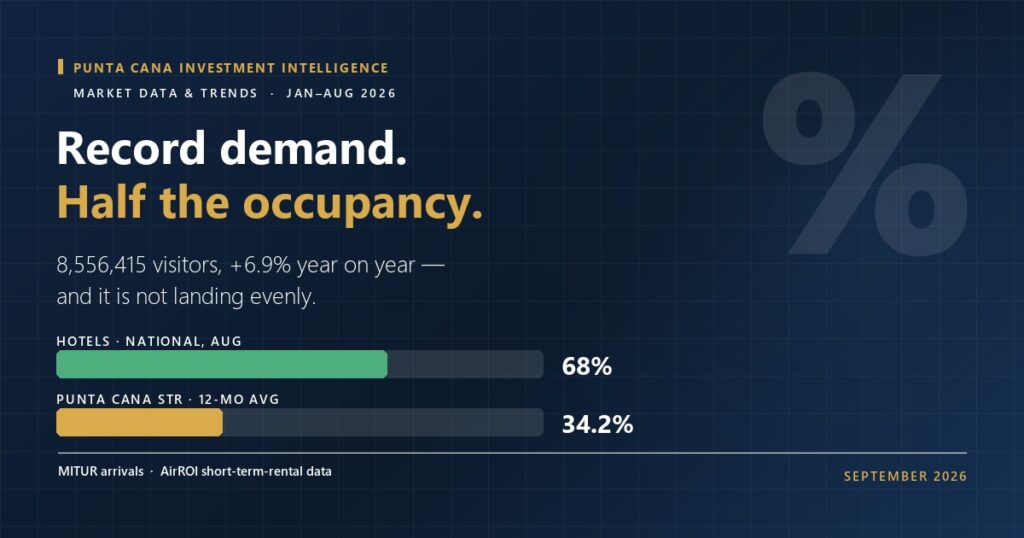
Most coverage treats this as a threat to owners. For a compliant, professionally managed unit, the honest answer is closer to the opposite. A registry that delists unregistered listings removes supply from a market where the average Punta Cana short-term rental already runs at 34.2% occupancy — and the listings least able to comply are, disproportionately, the informal and part-time ones competing on price.
The cost is real: paperwork, insurance, a local representative, and a condominium veto you may not control. The benefit is a thinner, more professional competitive set. If you are already running your unit as a business, formalisation is likelier to help you than hurt you. If your model depends on nobody asking questions, it is time to change the model.
For the supply-and-demand picture that registry sits inside, read 8.5 million visitors, 34% occupancy. And if you are buying rather than holding, the mechanics have not changed: the nine-step closing process is the same as it was.
Sources
- Acento, “Regulación de renta corta llega a consulta pública tras cuatro años de espera” — consultation dates, RENATUR scope, unit and hotel-room counts.
- Diario Libre, “Las plataformas digitales deberán excluir alojamientos de renta corta sin registro, propone el Mitur”, July 21, 2026 — the 60-day platform rule.
- Diario Libre, “Airbnb respalda el registro de alojamientos de renta corta en la República Dominicana”, July 22, 2026.
- Arecoa, “Los detalles de la regulación de Airbnb que plantea el Mitur”, July 27, 2026 — Jacqueline Mora on scope and taxes.
- El Inmobiliario, “RENATUR en pausa: qué proponía el borrador y qué sigue ahora” — withdrawal on July 20 and the detailed owner, administrator and platform obligations.
- Proceso / Resumen Turismo, “ADORECO destapa nueve grietas en proyecto RENATUR”, August 4, 2026 — the July 31 risk matrix and its objections.
- AirROI, Punta Cana short-term rental market report, updated September 12, 2026.
Status as of September 14, 2026: the RENATUR resolutions remain withdrawn and no replacement text has been published. Educational content, not legal or tax advice — confirm your specific situation with a Dominican attorney before acting on any of the above.